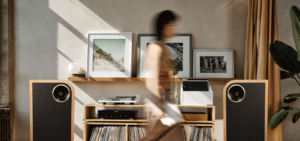
RIZZI is a Uruguayan Hi‑Fi audio systems brand born out of several years of research and prototyping, with the explicit goal of competing in the global market — starting in the United States and expanding from there to countries such as Brazil. Unlike many tech startups, the project emerged less from a corporate lab than from a garage-workshop ethos and a personal obsession with sound. Yet it went on to be validated at specialized trade shows, drawing interest from audio engineers at major companies like Sony Music.
Its flagship product, called ‘Owl’, is a sculpturally designed Hi‑Fi speaker system capable of delivering an experience comparable to very high-end equipment (priced above $20,000 USD), but at a significantly lower price point of around $4,400 USD — positioning the brand in a territory of aspirational yet more accessible high fidelity. The company defined itself as global from the outset: it operates in English, sells with international shipping, and was backed by the National Agency for Research and Innovation (ANII) as a technology innovation project, a key factor in streamlining production, standardizing the product, and initiating its commercial expansion.
On a human level, the founding team combines three very different perspectives: the person who carries the Rizzi name, who spent years obsessed with acoustic engineering and the search for a new way of listening; a musician who recognizes the product’s artistic and experiential potential; and an investor with a background in real estate, accustomed to thinking in terms of scalability and economic viability. This mix gives rise to a deeply passionate project, yet one with a clear ambition to become an international reference within the Hi‑Fi industry.
As a branding studio, we encountered a business at a very sensitive inflection point: proven technology, early market validation, a clear vision of competing globally — but a brand that still needed structure, its own voice, a robust visual system, and the tools to operate day-to-day without losing coherence. In that context, we began the collaborative process.

1. The real challenge
The core challenge was not “designing a nice logo” — it was building a brand platform capable of organizing a complex project: proprietary technology, a diverse team, global ambition, a high price point, and a demanding audience fluent in the language of high-fidelity audio. The risk was twofold: on one hand, sounding too technical and cold; on the other, falling into generic aspirational rhetoric that would fail to differentiate the product from brands with decades of history and deeply consolidated heritage.
Moreover, Rizzi Acoustics came to the project with some brand elements already sketched out by another consultancy, but without a unified strategic system. There were powerful intuitions — the combination of acoustic engineering and design object, the idea of an emotional experience, the global projection from Uruguay — but what was missing was a narrative capable of articulating all of it into a clear, scalable, and actionable story across communication, web, social media, commercial materials, and international presence.
We also faced a brand governance challenge: a founding team with very different profiles, all deeply involved, with perspectives that were sometimes complementary and sometimes in tension regarding what the brand should be. In contexts like this, the greatest danger is not a lack of ideas but fragmentation — tactical decisions driven by individual opinions rather than a shared strategic criterion. The brand risked being diluted before it had a chance to consolidate.
Another central challenge was, precisely, market globalization: today any audience searches and compares products across the entire world, which opens up an enormous range of options. In this landscape, Rizzi was competing not only against regional brands but against global benchmarks that often carry greater recognition, trust built over decades, or stronger propositions in areas such as price, design, or technology. This raised the bar for the brand even further: it was not enough to be “different” or “beautiful” — the brand needed to be credible, differentiated, and memorable in an environment of constant competition where consumers have every tool to compare in detail.
Finally, the product occupies a price point and a level of emotional sensitivity where branding is not decoration — it is part of the perceived value. A Hi‑Fi system costing several thousand dollars demands a brand universe that matches what the user sees, feels, and hears. The question was not “what does Rizzi look like,” but “what kind of trust, desire, and sense of belonging does the brand need to generate so that someone — in the United States or any other market — is willing to bet on a new brand over established giants.”
2. Strategic Decisions

When analyzing the competitive landscape, we concluded that positioning a new HiFi speaker brand in a competitive and growing market requires an even sharper focus — not just being good, but occupying a clear and defensible place within the category. While traditional HiFi brands dominate with premium products characterized by classic aesthetics, wood finishes, restrained forms, and a strongly marked technical heritage, and more disruptive brands tend to prioritize eye-catching designs sometimes at the expense of acoustic authenticity, RIZZI chose to occupy a middle ground that is nonetheless highly specific: innovative technology, yes — but with a visual and spatial interpretation that breaks from the traditional HiFi speaker code.

RIZZI’s positioning is built on three strategic pillars
- Authored technology, not just specifications The goal is not to compete line by line on data sheets, but to communicate that Owl is the result of years of acoustic research, prototyping, and a patent that solves concrete listening problems in real spaces The focus is less on generic high performance and more on acoustic engineering designed to structure the experience, not merely to play loud
- Authored design, not merely decorative aesthetics The Owl system does not aspire to be a neutral object or an empty luxury accessory, but a design piece with its own weight — sculptural, bold, yet carefully integrated into the interior It positions itself as an object of desire that coexists with high-level interior design, closer in feel to contemporary aesthetics and sculpture than to the classic speaker in the corner
- Emotional experience, not just technical fidelity RIZZI positions itself as a brand that understands listening as an intimate and sensory act — being able to hear details, feel the warmth of the sound, and build an atmosphere within everyday space This allows the brand to speak both to technical audiences such as audiophiles, musicians, and engineers, and to broader audiences who value aesthetics, design, and the emotional quality of their environment but do not necessarily speak the technical language of audio
From that foundation, three key decisions were made to reinforce this positioning:
- Position Rizzi as a global brand from Uruguay, not as a local brand that exports This translates into a communication tone in English, a narrative centered on emotions rather than local pride, and a presence in international spaces from the very beginning RIZZI does not present itself as the Uruguayan HiFi brand, but as a brand with Uruguayan origins that thinks and listens on a global scale
- Build an identity that combines precise engineering with aesthetic sensibility Visually and conceptually, the brand balances codes of precision — geometries, a neutral palette, clean typography — with signals of humanity and warmth: light, textures, moments of intimate listening This ensures that the visual world feels neither cold nor experimental, but considered, serious, and characterful
- Define clear rules to align a diverse founding team Decisions around communication, staging, language, and image usage are organized around a conceptual guide that establishes what belongs to the RIZZI universe and what does not, enabling a highly passionate and diverse team to participate in building the brand without diluting it
In parallel, a key strategic decision was made regarding our Studio’s role: not simply to deliver a visual identity, but to build a living brand system capable of operating in the real world across different actors, markets, and channels without requiring our constant presence. This was especially relevant in a context of growth, media appearances, trade show presence, investor contacts, and the expansion of the commercial network.
3. The System Created


In visual terms, the system seeks to balance classic elegance with modernity: an identity that can coexist equally in high-technology contexts and in interior design spaces. The logotype decision was resolved relatively quickly, but the real work lay in the “peripherals”: art direction, photography, graphic assets, the tone of marketing pieces, and how all of it built an atmosphere that felt at once sophisticated, warm, and contemporary.
The client felt that the initial visual approach was solid but “too safe” — too close to what had already been seen in the sector. That observation was pivotal in pushing the system toward a more daring territory, with greater personality and edge, without breaking from the standards of the category. To achieve this, the work focused on:
- A visual universe that embraces the idea of “immersive listening”: images that suggest depth, layering, and calm rather than stridency.
- A language of claims and messages that blends functional clarity with an emotional tone, inviting audiences to “connect with the sound and disconnect from the world” — consistent with the way the brand presents itself across social media and its broader communication.
- A conceptual guide that organizes future decisions: from the use of color and typography to the way the product is shown in interiors, what to emphasize on each platform, and how to speak about technology without losing humanity.
The result is a brand system that not only looks compelling, but articulates technology, design, emotion, and global ambition in a consistent, replicable, and adaptable language — ready for the different actors who will activate the brand: founders, commercial partners, agencies, media, and distributors.
5. Results

In terms of perception, the brand now appears in business media as a case study in Uruguayan innovation with global ambition — capable of competing in quality with luxury audio brands while maintaining a clear and distinctive identity of its own. Coverage in outlets such as Forbes Uruguay, a presence at specialized trade shows in the United States, and the expansion of the investor network all confirm that the branding did not remain at the aesthetic level, but contributed to building trust and readability in a demanding market.
In terms of order and clarity, the system created allows the brand to express itself coherently across its website, social media, commercial materials, and points of sale — always maintaining the same core message: proprietary acoustic engineering, considered design, and a sonic experience crafted for those who have a deep emotional relationship with music. The existence of a robust conceptual guide means the team can make communication decisions without relying on constant supervision from the studio — something fundamental as the company grows, enters new markets, and accelerates its production pace.
Scalability is evident, above all, on two levels: on one hand, in the brand’s capacity to support commercial expansion (international shipping, new partnerships, production in Asia without sacrificing quality control); on the other, in the way the brand language leaves room for future products without requiring a complete reinvention each time. The system is solid enough to sustain new product lines and flexible enough to adapt to different cultural and visual contexts.
Perhaps the most valuable indicator, from Estudio Nómade’s perspective, is that the brand lives and evolves without losing definition: Rizzi Acoustics continues to grow, refine its operations, and open new markets — but it does so within the strategic and visual framework that was built. This confirms something that guides our work on high-value projects: the goal is not for the brand to depend on us, but for it to be able to inhabit the real world — with all its tensions, demands, and opportunities — without losing its essence.
Take a closer look at this project in our portfolio. You can also visit the brand’s website to see it live and explore the project: https://rizziacoustics.com/