At Estudio Nómade, we believe the true value of branding emerges when a brand can grow, evolve, and adapt without losing clarity. MP – Medicina Personalizada is a strong example of this: a private healthcare institution with more than 30 years of history in Uruguay, one of the country’s leading and most respected private health insurance providers, serving thousands of members through a robust brand architecture.
The challenge was to redefine the role of one of its regional sub-brands while preserving everything that was already working well within the broader ecosystem.
The Challenge: MP Punta
This article tells, from our perspective, how we worked alongside MP’s team to reposition MP Punta, the sub-brand focused on the Maldonado region. The challenge was not to create something new just for the sake of change, but to strengthen an existing presence that had become seasonal, irregular, and misaligned with the parent brand’s essence. Our objective was clear: to turn MP Punta into a constant, approachable, and recognizable presence for those living in the area year-round, respecting the history and standards of a leading healthcare system in the country.
1. Business Context
MP Medicina Personalizada is one of Uruguay’s most recognized private healthcare providers, with more than 30 years of history since its founding in 1994 by a group of physicians who set out to create a healthcare system they would trust for their own families. Over the past three decades, the organization has evolved into a benchmark premium medical insurance provider, serving more than 31,000 members and continuously expanding its infrastructure, establishing itself as one of the leading players in Uruguay’s private healthcare sector.
Today, MP delivers comprehensive healthcare coverage with a strong focus on prevention and primary care. Its model integrates pre-hospital services, outpatient care, and hospitalization through a network of exclusive clinics and affiliated medical centers. The organization operates at least five proprietary clinics in Montevideo—Setiembre, Golf, Carrasco, Horneros, and its Central Headquarters—as well as Clínica MP in Punta del Este and the SEMM-Mautone healthcare network across Maldonado, San Carlos, Piriápolis, and Pan de Azúcar. This extensive infrastructure reinforces MP’s presence throughout Uruguay’s eastern region and supports its commitment to providing high-quality care close to where its members live and work.

Although Montevideo has always been MP’s primary focus, the organization also maintains a significant presence in the Maldonado region through MP Punta, a sub-brand created to serve people who live in the area year-round. In practice, however, we found that MP Punta had gradually become associated with the summer season and with highly specific initiatives tied to tourism, beach culture, and the influx of seasonal visitors. This created a disconnect between the sub-brand’s actual target audience—local residents—and the image it was projecting.
MP’s brand architecture includes several extensions dedicated to specific services, such as women’s health and specialized medical programs. Each of these operates under a shared framework of values, visual standards, and brand principles. MP Punta was part of this ecosystem, but its evolution had been less consistent. Over the years, its original visual identity had been repeatedly altered, reinterpreted, and adapted—often driven by tactical marketing needs rather than long-term brand strategy. When we assessed the situation, we found a sub-brand with genuine regional relevance, but one that lacked visual consistency, communicated an unclear narrative, and was strongly associated with seasonality.
Within this context, MP decided to give MP Punta a more prominent role in its long-term strategy for Maldonado and approached us to help shape that transformation. A significant reason behind that decision was our shared connection to Punta del Este, combined with our experience developing brands from a global perspective. That dual viewpoint—understanding the territory from within while operating according to contemporary international branding standards—became a key component of how we framed and approached the project.
2. The Real Problem
MP Punta’s problem was not just about design, but about strategic coherence. The sub-brand was communicating something that contradicted MP’s essence as a company: while the parent brand relies on consistency, predictability, and long-term support, MP Punta appeared to the public as an intermittent presence that turned on in summer and went silent the rest of the year. This perception undermined the stability message that a healthcare brand needs to convey in any territory.
From a visual standpoint, the diagnosis was clear: over time, MP Punta’s identity had accumulated a series of small modifications that, collectively, resulted in an inconsistent brand system. Different versions of the logo, unregulated typographic adjustments, color palette expansions without a central rationale, and graphic resources that drifted away from MP’s institutional visual universe. None of these issues represented a major problem on their own, but together they projected an image that felt outdated, less professional, and, most importantly, disconnected from the parent brand.
The challenge, however, extended well beyond the visual identity. From the outset, the commercial team was actively involved and brought a set of clear business objectives to the table:
- Increase awareness of MP Punta as a reliable, year-round healthcare option for Maldonado residents.
- Translate that visibility into tangible interest and new memberships.
- Strengthen trust in the brand within a highly competitive local and regional healthcare landscape.
This business dimension added an important layer of complexity: every branding decision needed to support measurable outcomes, not just improve aesthetic perception.
From a positioning perspective, MP Punta also faced a unique challenge. It needed to be perceived as a local, approachable brand—one that genuinely belongs to the region—without compromising the credibility, professionalism, and institutional strength that healthcare services demand. The experience had to feel embedded in everyday life in Maldonado, but not like a “beach brand” or a seasonal campaign that disappears once summer ends.
For us, the real challenge was integrating three distinct layers into a single strategic move:
- Reconnect MP Punta with the core DNA of the MP brand.
- Define a clear and meaningful role for the sub-brand in the lives of people who live in Maldonado year-round.
- Design a narrative and visual system capable of sustaining long-term relevance, rather than supporting a single campaign or moment in time.
3. Strategic Decisions
From the start, we understood that we were not facing a blank slate rebranding, but a profound reframing of a sub-brand with established history and codes. We recovered MP’s original structure to restore the technical order that had eroded, reviewing logo, visual codes, typography, proportions, and color palette. From that foundation, we designed specific variations for MP Punta that would allow the sub-brand to differentiate itself without losing its institutional link to the parent brand.

In practice, we made a series of deliberate strategic decisions.
First, when structuring the project team, we chose to involve two brand strategists during the discovery phase, each with a deliberately complementary role. One perspective was rooted in a deep understanding of the local territory, its dynamics, and the culture of Maldonado. The other focused on global healthcare branding standards, international benchmarks, and broader category-level insights.
This approach allowed our research to explore several dimensions simultaneously:
- How users make healthcare decisions in comparable markets.
- The levels of credibility, accessibility, and clarity expected from private healthcare brands.
- Opportunities to differentiate a regional sub-brand without compromising the integrity of the parent brand.
Second, from a visual identity perspective, we decided not to create an entirely new brand. Instead, we returned to MP’s original brand structure in order to restore the technical consistency that had gradually eroded over time. We reviewed the logo, visual codes, typography, proportions, color palette, and a range of incorrect applications that had become normalized over the years.
Building on that foundation, we developed specific adaptations for MP Punta that would:
- Reconnect the sub-brand with the parent brand, reinforcing coherence and a sense of belonging.
- Introduce subtle regional nuances linked to Maldonado without relying on beach or summer-related iconography.
- Preserve the professional, trustworthy, and understated tone required within the healthcare sector.
Third, we incorporated an internal media planning and advertising perspective into our conversations with MP’s marketing team. We knew there was already a media strategy informed by previous experience, and we wanted to respect that accumulated knowledge while also evaluating it critically. This enabled us to:
- Assess which channels remained effective for MP Punta’s current objectives.
- Refine the balance between traditional and digital media.
- Align messaging and creative assets with specific stages of the customer journey.
Finally, we designed a working methodology based on continuous collaboration. We did not want a traditional “brief-and-delivery” process; we wanted an ongoing dialogue. To achieve this, we established a framework of recurring meetings, collaborative review sessions, and iterative presentations involving marketing, sales, and leadership teams.
For us, this was not simply a project management decision—it was part of the strategic approach itself. In healthcare, internal perceptions are often just as important as external ones, and we wanted the brand system to be informed by the real-world experience, knowledge, and perspective of the people who represent it every day.
Brand Systems Created
With the strategic framework clearly defined, our next step was to build a system capable of operating across three levels: conceptual, visual, and operational. We were not interested in creating a brilliant but isolated campaign; we wanted to develop an interconnected set of decisions that the brand could sustain, scale, and replicate over time.
During our first major presentation, we shared our analysis and diagnosis of MP Punta, along with a new conceptual direction for the sub-brand. We proposed moving away from seasonality as the central narrative and instead focusing on the ideas of support, belonging, and continuity.
We defined a conceptual territory in which people—particularly families, year-round residents, and local communities—became the focal point. Within this framework, MP Punta emerged as a trusted and dependable presence: a brand that remains close, relevant, and consistent, even when everything else around it changes.

From that foundation, we developed the system across multiple layers:
Refined Visual Identity for MP Punta
We carried out a technical evolution of the sub-brand’s identity, carefully realigning it with the broader MP brand while introducing subtle cues connected to the local territory. We organized the use of the logo and its variations, refined the color palette, established typography standards, hierarchy systems, and layout principles, and defined guidelines for photography and graphic assets. Our objective was simple: every new touchpoint should reinforce the MP Punta universe rather than contribute to further visual fragmentation.
A Unifying Creative Concept
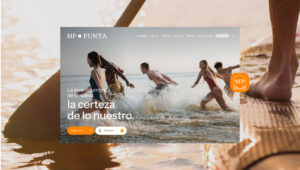
We adopted “The uncertainty of what’s new, the certainty of what’s ours” as the narrative anchor of the entire system. From our perspective, this idea perfectly captured the tension we wanted to address: the inevitable changes people experience throughout life and, in contrast, the things that remain constant. It allowed us to connect with real-life moments—relocations, family transitions, new life stages—and position MP Punta as the familiar and trusted presence that provides confidence and reassurance through change.
A Coordinated 360° Campaign
We designed an integrated campaign spanning both offline and online channels. For traditional media, we developed radio spots, magazine advertisements, outdoor graphics, and a range of physical materials, including merchandising and activation assets. Within the digital ecosystem, we created a dedicated landing page for MP Punta, email marketing flows, organic social media content, and a complete set of paid-media creative assets, with a particular focus on Meta platforms.
Across every channel and format, we ensured that each execution remained aligned with the same strategic concept and visual system, creating a consistent and recognizable brand experience.
Sustained Collaboration with the Client
Following the initial strategic phase, we restructured the project around a lead creative strategist working in close partnership with art direction. Throughout the process, we kept the client actively involved, incorporating their understanding of the territory, day-to-day insights, feedback from commercial teams, and early performance indicators.
For us, this collaborative dynamic is not simply a project methodology—it is a fundamental part of how we build brand systems that are adopted, maintained, and genuinely integrated into the organization over time.
4. Results

The system we designed came to life through a multi-month campaign that reached its highest level of visibility during the summer season in Maldonado, but whose impact extended far beyond those months. One of the most tangible changes was the shift from communication concentrated almost exclusively in December and January to a consistent, year-round presence across both traditional and digital channels. MP Punta stopped “showing up only in summer” and became a constant presence in the everyday lives of people who live in the region.
From a brand experience perspective, audiences encountered the same tone, visual language, and core message across radio, magazines, outdoor advertising, in-person activations, merchandising, the dedicated landing page, email marketing, social media, and digital advertising. That consistency was precisely what we set out to achieve: a sub-brand that felt professional, approachable, and dependable—fully aligned with the prestige of MP Medicina Personalizada while remaining authentically connected to its local territory.
From our perspective, another key outcome was the internal impact. MP Punta’s marketing and sales teams were left with a clear conceptual and visual framework that they could continue to use, adapt, and expand without having to redefine the brand each time. The sub-brand began to be viewed internally as a long-term strategic asset rather than a seasonal tactical campaign. That kind of operational clarity is one of the metrics we value most when building brands that need to function every day, not just in presentations.
Perhaps the strongest indicator of trust came afterward. As a direct result of this project, MP decided to move forward with us on a broader review of the parent brand, and we are now beginning a comprehensive brand evolution process for MP Montevideo. For an organization with more than 30 years of history to entrust us with the future of its core brand is a meaningful signal that the work developed for MP Punta generated not only external impact, but also internal alignment, clarity, and confidence.
Discover the full MP Punta project in our portfolio.
Explore other branding and development case studies on our blog.